
Cooking-Line Grease
Hot oil and airborne cooking residue settle near fryers, ranges, and prep lines. Degreasing targets the bonded film that repeated wet mopping may spread across the surface.
Serving Austin, Texas & surrounding areas
Open 24/7
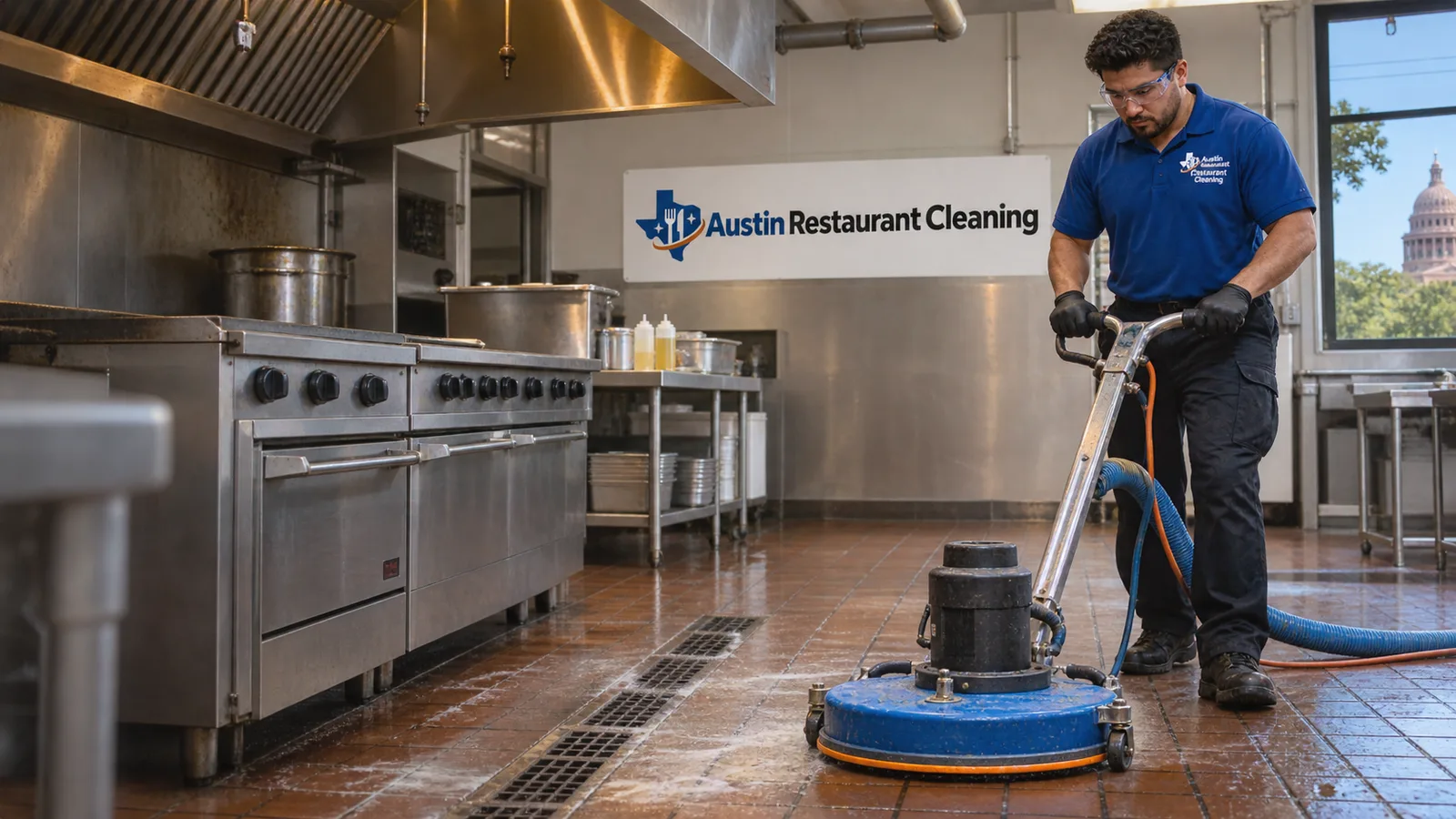
Kitchen floor cleaning · Austin, Texas
Remove built-up grease, food residue, and soil from restaurant tile and grout with a cleaning plan fitted to your kitchen, flooring, and operating schedule.
Beyond routine mopping
Commercial Kitchen Floor Cleaning addresses the residue that ordinary mopping often leaves behind. Cooking oil, tracked-in soil, food particles, and detergent film can collect on textured tile, in grout joints, along walls, and beneath equipment edges. The result is a floor that can remain dull or slick even after routine closing duties.
Austin Restaurant Cleaning approaches each job according to the floor material, soil load, kitchen layout, and access window. For every job, an experienced restaurant service team in Austin, TX inspects the surface, identifies greasy traffic lanes and neglected edges, and selects a cleaning method that fits the space. Our goal is to release adhered soil without flooding sensitive areas or applying a chemical that is unsuitable for the flooring.
Professional cleaning supports daily maintenance rather than replacing it. Regular sweeping and mopping still matter, but periodic deep cleaning reaches porous grout, textured surfaces, corners, and buildup around fixed equipment. A written scope can define which areas are included, how equipment access will be handled, and whether the work is a one-time reset or part of a recurring schedule.
Surface-specific methods
Effective kitchen floor degreasing starts with chemistry and dwell time. A suitable alkaline degreaser needs time to loosen fats and oils before agitation. Applying more chemical is not a substitute for correct dilution, and letting a product dry on the floor can leave residue. The cleaning solution must also be compatible with the tile, grout, and any sealer already present.
After loose debris is removed, the degreaser is applied to manageable areas. Mechanical agitation with a floor machine, deck brush, or grout brush helps break the bond between the floor and compacted soil. The slurry is then recovered rather than pushed into corners. Thorough rinsing removes suspended grease and detergent film, and controlled extraction limits the amount of wastewater left near equipment or floor transitions.
Austin's long stretches of warm weather can support extended patio service and steady foot traffic, which means kitchen entrances and service paths may collect soil throughout much of the year. In East Austin, dense restaurant corridors around East Cesar Chavez Street can also involve compact kitchens with tight equipment spacing. Those conditions make edge work, controlled application, and practical scheduling especially important.
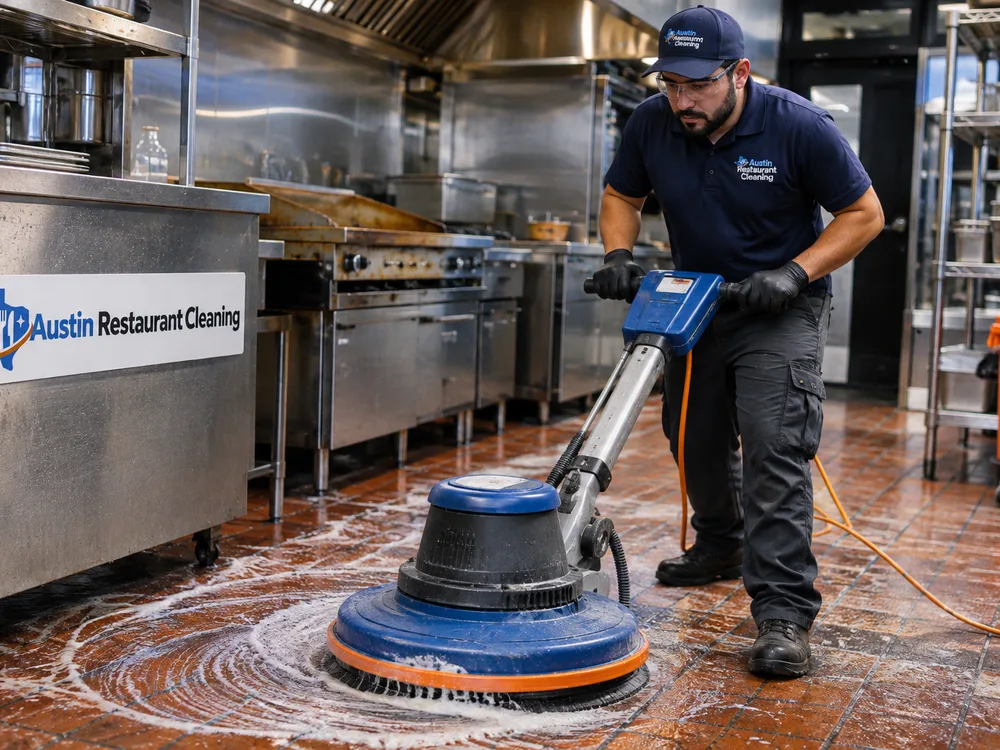
Floor cleaning zones
Hot oil and airborne cooking residue settle near fryers, ranges, and prep lines. Degreasing targets the bonded film that repeated wet mopping may spread across the surface.
Textured quarry tile, ceramic tile, and other common commercial surfaces require compatible chemicals and enough agitation to clean low points without damaging the finish.
Grout joints hold darkened soil and grease below the face of the tile. Focused brushing and extraction remove loosened residue, although permanent staining or failed grout may remain.
Hand detailing addresses wall edges, corners, thresholds, floor transitions, and accessible gaps around fixed equipment where larger machines cannot reach.
When included in the scope, cleaning can cover the tile paths connecting the kitchen, dish area, pickup points, and dining room to reduce tracked residue.
Scheduled service helps prevent heavy accumulation. Frequency depends on cooking volume, floor texture, nightly procedures, and the amount of soil entering through doors.
Controlled cleaning sequence
Each visit moves from floor and access review through preparation, controlled degreasing, extraction, inspection, and maintenance planning.
We review the flooring, grease concentration, grout condition, floor drains, equipment clearances, and areas that must remain accessible. Existing damage, loose grout, or sensitive transitions should be identified before cleaning starts.
Loose debris is removed, movable items are addressed according to the agreed scope, and nearby surfaces are protected as needed. Work zones help keep cleaning solution away from active food preparation.
A compatible product is diluted and applied in controlled areas. Proper dwell time gives the chemistry a chance to soften greasy buildup before scrubbing.
Mechanical scrubbing treats open floor areas while hand tools reach grout lines, corners, thresholds, and accessible equipment edges. Extra passes may be needed in cooking lanes.
The loosened slurry is collected, and the floor is rinsed to remove soil and chemical residue. Extraction is useful because it removes wastewater instead of redistributing it.
We inspect the cleaned areas after recovery and discuss practical upkeep. Recurring intervals can be adjusted when menu changes, traffic, or operating hours alter the grease load.
Austin service planning
A useful cleaning plan accounts for how the restaurant actually runs. Downtown Austin kitchens may have narrow delivery windows, limited loading access, and late closing times. South Congress restaurants often balance kitchen service with heavy pedestrian activity and customer-facing entrances. The Domain has many restaurants in mixed-use developments, where building access and after-hours procedures may affect scheduling. In Mueller, dining spaces within a planned mixed-use district can require coordination with property rules and shared access points.
These operating details affect arrival, equipment movement, drying time, and which areas can be cleaned in one visit. Work is generally easiest when cooking has stopped, loose food has been cleared, and staff movement through the cleaning zone is limited. A compact kitchen may need to be handled in stages so exits, refrigeration, or essential pathways remain available.
Austin Restaurant Cleaning is based at 2411 E Cesar Chavez St, Suite 4, Austin, TX 78702. Before work begins, we can discuss floor type, approximate area, equipment access, problem zones, and the time available between closing and the next shift. That information supports a realistic scope for commercial floor cleaning in Austin restaurants.

Realistic floor-care outcomes
A deep cleaning can remove grease film, embedded soil, food residue, and detergent buildup when those materials are sitting on or within a cleanable surface. It may brighten grout and restore traction that was reduced by greasy residue. Results depend on the flooring's age, porosity, maintenance history, and physical condition.
Cleaning cannot repair cracked tile, missing grout, loose transitions, failed coatings, or drainage problems. It may not remove permanent discoloration caused by absorbed oil, chemical damage, or worn grout. If a coating or sealer has deteriorated, aggressive cleaning may reveal the underlying wear rather than create a uniform finish. Those conditions should be documented so cleaning and repair are not confused.
Slip resistance also depends on more than appearance. Floor texture, footwear, contaminants, drainage, and current maintenance practices all matter. Staff should keep using wet-floor controls and established safety procedures while a cleaned floor dries. Professional restaurant floor degreasing is one part of floor care, not a substitute for prompt spill response or sound flooring.
Pricing factors
Commercial kitchen floor cleaning in Austin typically costs about $300 to $1,200 per visit, while large, heavily soiled, or difficult-access kitchens may cost more. A compact kitchen with open tile usually falls toward the lower end; extensive grout detailing and dense equipment layouts raise labor time.
Final pricing depends on square footage, grease buildup, floor material, equipment clearance, water access, service timing, and whether dining or service areas are included. Recurring maintenance may be priced differently from a one-time restorative cleaning. The exact cost is confirmed after the floor and work conditions are reviewed.
Check AvailabilityDescribe the floor material, kitchen size, grease buildup, and preferred service window to receive a cleaning scope built around your operation.
Call to ScheduleScope and scheduling
Answers about cleaning frequency, grout results, drying time, equipment access, after-hours service, food areas, and estimates.
The right interval depends on cooking volume, menu, floor texture, and the quality of nightly cleaning. Fry-heavy kitchens and porous grout generally need professional degreasing more often than lower-grease operations. A recurring plan should be adjusted after seeing how quickly residue returns during Austin's long warm-weather service periods.
Restaurant grout cleaning can remove dark grease and soil, but it cannot reverse every type of discoloration. Absorbed oil, worn grout, chemical damage, and failed sealer may leave permanent color variation. A test area can help separate removable buildup from staining or material failure.
Drying time varies with floor texture, extraction quality, ventilation, humidity, and the amount of rinse water used. Recovery equipment can remove much of the wastewater, but textured tile and grout joints may retain moisture longer. Austin restaurants should allow a practical buffer before staff return to the cleaned zone.
Equipment movement must be agreed upon before service because many commercial appliances are heavy, connected to utilities, or fixed in place. Lightweight movable items may be handled within the scope, while connected cooking equipment generally remains stationary. Accessible edges and gaps can still receive hand detailing.
After-hours service may be possible when access, noise limits, building procedures, and the drying window allow it. Downtown and mixed-use Austin properties can have specific loading or entry rules, so those details should be confirmed when scheduling. The kitchen should be out of active food production during degreasing.
It can be performed safely when food is removed or protected, the work area is controlled, compatible products are used, and residues are thoroughly recovered and rinsed. Cleaning should occur outside active preparation whenever possible. Staff should keep food, utensils, and movable ingredients away from the treatment zone.
Useful details include approximate floor area, flooring material, grease level, grout condition, equipment spacing, floor-drain locations, water access, and the available service window. Photos of the cooking line, dish area, thresholds, and problem spots can clarify the scope before an on-site review.
Tell Austin Restaurant Cleaning where grease and grime are building up, and our team will outline a practical approach for tile, grout, edges, and high-traffic kitchen paths.